
Geothermal Heating and Cooling Myths, Debunked for Colorado Homes
Geothermal heating and cooling uses a ground-source heat pump to move heat between your home and the stable earth a few feet below the surface. Because ground temperatures along the Front Range hold near 50°F year-round, the system heats efficiently through cold Colorado winters and cools through hot, dry summers. Most of what homeowners think they know about geothermal is outdated myth.
The licensed, bonded, and insured team at 1st Choice Pro Services installs and services heating and cooling systems across Parker, Castle Rock, Castle Pines, Centennial, and Highlands Ranch. Below we separate the common geothermal myths from what actually happens once a properly sized system is in the ground.
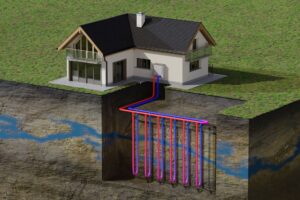
How Geothermal Heating and Cooling Actually Works
A geothermal system has three parts: a buried ground loop, an indoor heat pump, and a distribution system such as ductwork or radiant floors. In winter, fluid circulating through the loop absorbs low-grade heat from the soil and the heat pump concentrates it to warm your home. In summer, the process reverses and pulls heat out of the house, sending it back into the cooler ground. There is no combustion and no outdoor condenser roasting in the July sun.
Loops come in two families. Closed-loop systems circulate a water-and-antifreeze mix through sealed pipe, arranged horizontally in trenches about 4 to 6 feet deep or vertically in boreholes drilled 150 to 400 feet down. Open-loop systems pull from a well and discharge the water afterward, which is less common on most residential lots.
Myth 1: “Geothermal Doesn’t Work in Cold Colorado Winters”
This is the myth that keeps the most Front Range homeowners from even asking, and it has things backwards. Air-source heat pumps lose capacity as the outdoor air drops toward single digits, but a geothermal loop is pulling from soil that stays near 50°F no matter what the thermometer reads. Whether it is 40°F or -10°F outside, the ground temperature the system draws on barely moves, so heating output stays steady through a January cold snap.
Altitude matters here too. At roughly a mile above sea level in Parker and Castle Rock, combustion furnaces and air-source equipment lose some rated capacity in the thinner air. A ground-source heat pump is not pulling heat from cold, thin air, so elevation has far less effect on its performance.
Myth 2: “The Installation Cost Never Pays Off”
Geothermal heating cost is real, and we will not pretend otherwise. A full residential system on the Front Range commonly runs from about $20,000 to $35,000 installed before incentives, driven mostly by loop type – vertical drilling costs more than horizontal trenching – and the size of your home. That is a larger upfront number than a standard furnace-and-air-conditioner swap.
The payback comes from efficiency. A ground-source heat pump typically delivers 3 to 5 units of heating or cooling for every unit of electricity it uses, which trims your monthly bills year after year. Federal tax credits and local utility rebates have historically covered a meaningful share of the cost as well. Because those programs change, ask us or your tax professional what is currently available before you finalize a budget.
Myth 3: “You Need a Big Rural Lot”
Horizontal loops do want room, but they are not the only option. Vertical loops send the pipe straight down in boreholes only a few inches wide, so the surface footprint is small enough for typical suburban lots in Highlands Ranch or Centennial. Many homes that could never fit a horizontal field still qualify for a vertical system. Where a property has a pond or another suitable water source, a submerged loop is a further space-saving choice.
Myth 4: “Geothermal Only Works in New Construction”
Existing homes are retrofitted with geothermal regularly. The indoor heat pump ties into the ductwork you already have in most cases, so you rarely need to gut the house. The bigger planning questions are yard access for the loop crew and whether your current ducts are sized correctly. A load calculation tells us what your home actually needs before anyone digs.
Myth 5: “The System Is Too Complex and Always Breaking”
Geothermal systems have fewer exposed parts than a conventional setup, not more. The buried loop has no moving components and commonly lasts 50 years or longer. The indoor heat pump typically runs 20 to 25 years, and because it sits inside, it is not being pounded by Front Range hail, snow, and UV the way an outdoor AC condenser is. Maintenance is straightforward: change or check the filter on schedule and have a technician inspect the system periodically.
Is Geothermal Right for Your Front Range Home?
Geothermal makes the most sense for homeowners planning to stay put long enough to earn back the upfront cost, and for homes where we can reach the yard to install the loop. It is not the only good option – a high-efficiency furnace or a cold-climate air-source heat pump may fit your budget and timeline better. The right answer starts with a load calculation and an honest look at your lot, not a sales pitch.
Frequently Asked Questions
How much does geothermal cost to install near Parker, CO?
Most residential systems in the south Denver metro run from roughly $20,000 to $35,000 installed before incentives. Vertical loops cost more than horizontal trenching, and larger homes need larger systems. A site visit and load calculation give you a firm number.
Will geothermal keep up during a Colorado cold snap?
Yes. Because the loop draws heat from soil that stays near 50°F, output holds steady even when outdoor air drops below 0°F, which is exactly when air-source equipment struggles most.
Can geothermal fit a smaller Highlands Ranch or Centennial lot?
Often, yes. Vertical boreholes take up very little surface area, so many suburban lots that cannot fit a horizontal loop field still support a vertical system.
Do I have to replace my ductwork?
Usually not. In most retrofits the geothermal heat pump connects to your existing ducts. We confirm your ducts are properly sized during the assessment and adjust only if needed.
Geothermal heating and cooling is not the mysterious, cold-weather-averse technology the myths make it out to be – it is a proven, efficient way to heat and cool a Colorado home. If you are weighing geothermal against a new furnace or heat pump for your Parker, Castle Rock, or Centennial home, the licensed team at 1st Choice Pro Services will walk your property, run the numbers, and give you a straight recommendation. Call us at 303-841-1448 to schedule a consultation.
Key Takeaways
Try to determine if the weak flush is due to low tank water, mechanical parts, or a partial clog and note if any waste remains…

Key Takeaways
Hot water tank efficiency, insulation and heat loss. Standby heat loss from your hot water tank is the equivalent of the…