Commercial Kitchen Ventilation Requirements: A Practical Guide
Commercial kitchen ventilation requirements are the building-code and safety standards that control the grease-laden smoke, heat, and steam that cooking equipment produces. Along Colorado’s Front Range they are driven mainly by NFPA 96 and the International Mechanical Code adopted by your local jurisdiction, and they govern hood type, exhaust airflow, make-up air, welded ductwork, fire suppression, and how often the system must be cleaned.
The exact figures that apply to your kitchen depend on what you cook, how much of it you cook, and which authority has jurisdiction. Parker, Castle Rock, Centennial, Highlands Ranch, and unincorporated Douglas and Arapahoe counties each enforce the adopted code through their own plan review and inspectors. A licensed HVAC contractor should size, permit, and commission the system so it passes inspection the first time. The sections below explain what those requirements actually mean for a South Denver kitchen.
The two hood types every commercial kitchen uses
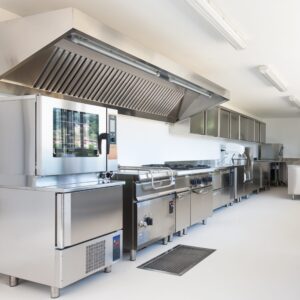
Kitchen exhaust hoods fall into two code categories, and the difference decides almost everything else about your system. A Type I hood is required over any appliance that produces grease or smoke – deep fryers, griddles, ranges, charbroilers, and salamanders. Type I hoods must be built of welded, liquid-tight steel or stainless steel, fitted with listed grease baffle filters, and protected by a fire-suppression system. A Type II hood handles heat, steam, and condensate only, over equipment like dishwashers, steam kettles, and some ovens, and it is not permitted over grease-producing appliances.
| Hood type | Handles | Typical appliances | Key requirement |
|---|---|---|---|
| Type I | Grease and smoke | Fryers, griddles, charbroilers, ranges | Welded duct plus fire suppression |
| Type II | Heat, steam, odor | Dishwashers, steamers, some ovens | Condensate control, no grease loads |
Putting the wrong hood over the wrong equipment is one of the most common reasons a plan review gets rejected. When in doubt, match the hood to the greasiest, hottest appliance in the lineup.
Exhaust airflow and hood sizing
A hood only works if it captures and contains the plume of hot air rising off the cooktop before it spills into the room. Two things make that happen: enough exhaust volume, measured in cubic feet per minute (CFM), and a hood large enough to overhang the cooking surface. As a general design rule, the hood should overhang the open sides of the appliance line by about 6 inches so the plume cannot escape past the edge. The required CFM is set by the code and the type and BTU rating of the equipment underneath.
Undersized exhaust leaves smoke and heat hanging in the kitchen and can fail a capture-and-containment test at final inspection. Oversized exhaust wastes energy and pulls conditioned air straight out of the building, which is expensive in both summer and a Colorado winter. Getting the CFM right the first time is worth a proper load calculation rather than a rule-of-thumb guess.
Make-up air: the piece Front Range kitchens cannot skip
Every cubic foot of air a hood pulls out has to be replaced. That replacement air is called make-up air, and it is where a lot of Denver-area kitchens run into trouble. Code generally requires a dedicated make-up air supply once exhaust passes a set threshold, and the supply is usually tuned to roughly 80 to 90 percent of the exhaust volume so the kitchen holds a slight negative pressure. Too much negative pressure and doors become hard to open, pilot lights blow out, and other gas appliances can backdraft combustion gases into the space.
In our climate, raw outside make-up air is a problem for about half the year. On a single-digit January morning in Parker or Castle Pines, dumping 3,000 CFM of unheated outside air into a kitchen is neither comfortable nor code-friendly. That is why Front Range kitchens typically need a tempered make-up air unit that warms incoming air before it reaches the cook line, along with freeze protection so the unit itself survives a cold snap.
Ductwork, fans, and fire suppression
Type I exhaust duct is not ordinary sheet metal. It has to be continuously welded and liquid-tight so grease cannot leak into the building cavity, sloped to drain back toward the hood or a collection point, and fitted with access panels for cleaning. The duct usually terminates at an upblast exhaust fan on the roof, hinged so a cleaning crew can lift it and reach the ductwork below.
The fire-suppression system is the other non-negotiable piece over grease appliances. Modern systems use a wet-chemical agent listed to UL 300, with nozzles aimed at each cooking appliance and at the duct opening, and an interlock that shuts off gas and the exhaust fan when it discharges. Suppression systems require regular certified inspection, and that paperwork is exactly what your local fire marshal will ask to see.
Grease cleaning and inspection schedules
NFPA 96 ties cleaning frequency to how hard the kitchen runs rather than a single calendar rule. Solid-fuel cooking, like a wood or charcoal grill, needs the most frequent attention, high-volume operations are commonly on a monthly or quarterly cycle, moderate-volume kitchens are often semiannual, and low-volume operations may be annual. Grease baffle filters need far more frequent care – most kitchens pull and clean them on a schedule measured in days, not months, because a clogged filter both starves airflow and feeds a grease fire.
| Cooking volume | Typical exhaust cleaning interval |
|---|---|
| Solid fuel (wood, charcoal) | Monthly |
| High volume (24-hour, heavy fry) | Monthly to quarterly |
| Moderate volume | Semiannually |
| Low volume (churches, seasonal) | Annually |
Keep dated records of every cleaning, filter change, and suppression-system certification. Those logs are not just good housekeeping – inspectors and insurers can require them, and they are what protects you if there is ever a claim.
How altitude and Colorado weather change the design
At roughly a mile above sea level, the air over Parker is about 15 to 17 percent thinner than at the coast, and that matters twice over. First, gas cooking appliances have to be derated for altitude, which changes their BTU input and therefore the exhaust airflow the hood needs. Second, fans move a mass of air, and thinner air means a fan rated at sea level does not perform the same here, so airflow calculations should account for local air density rather than the factory nameplate.
The seasons pile on more. Hot, dry summers push cooling loads while the exhaust system is fighting to keep the kitchen livable, and long cold winters make tempered make-up air and freeze protection essential. A design that works fine in a mild coastal climate can leave a Front Range kitchen either freezing or failing inspection, which is why local experience is worth as much as the code book here.
Frequently asked questions
What is the difference between a Type I and Type II hood?
A Type I hood is required over grease- and smoke-producing equipment such as fryers, griddles, and charbroilers, and it must include welded duct and fire suppression. A Type II hood only handles heat, steam, and condensate over equipment like dishwashers and is never used over grease loads.
How often does a commercial kitchen exhaust system need cleaning?
It depends on how hard you cook. NFPA 96 ranges from monthly for solid-fuel and heavy-volume kitchens to annually for low-volume operations, while grease filters are usually cleaned every few days. When in doubt, clean more often rather than less.
Does my kitchen really need make-up air?
Almost certainly, once exhaust passes the code threshold. Without make-up air the kitchen goes strongly negative, which makes doors hard to open, snuffs pilot lights, and can backdraft combustion gases. In Colorado that make-up air usually needs to be heated in winter.
Does Front Range altitude change ventilation requirements?
Yes. Gas appliances are derated for altitude, and fans move thinner air, so exhaust CFM and equipment selection should be calculated for local elevation. A design copied from a sea-level project can come out undersized or oversized here.
Talk to a Front Range HVAC pro before you build or remodel
Commercial kitchen ventilation is one of those systems where the code, the equipment, and the climate all have to line up, and fixing a design after the drywall is up gets expensive fast. If you are planning a new kitchen, adding a cook line, or trying to pass a stalled inspection anywhere from Parker to Castle Rock, Castle Pines, Centennial, or Highlands Ranch, the team at 1st Choice Pro Services can size the hood, exhaust, and make-up air for your equipment and our altitude. Call 303-841-1448 to set up an on-site assessment.

Key Takeaways
Understand typical issues such as drain clogs, incorrect installation, and pump or hose malfunctions to target fixes where…
Key Takeaways
We recommend changing your evaporator pad at least once a year, prior to the heating season. Coordinate the change with…