
How an HVAC Economizer Saves Your Business Money
An HVAC economizer is a set of dampers, sensors, and controls built into a commercial rooftop unit or air handler that pulls in cool outdoor air to cool your building instead of running the air conditioner’s compressor. When the air outside is cooler than the air you want inside, the economizer opens and delivers “free cooling,” which lowers the electricity your cooling equipment draws and trims your monthly energy bill.
Economizers earn their keep in dry climates with wide day-to-night temperature swings, which describes Colorado’s Front Range almost perfectly. Across Parker, Castle Rock, Castle Pines, Centennial, and Highlands Ranch, summer afternoons run hot while mornings and evenings stay cool and dry, so a well-tuned economizer can offset mechanical cooling for a meaningful share of the season.
What Is an HVAC Economizer?
An economizer is not a separate machine bolted onto your building – it is a built-in feature of most commercial packaged rooftop units and many air handlers. It uses outdoor air as a source of cooling whenever conditions allow, letting the compressor stay off or run at a lighter load. On a 60°F morning, an office may still need cooling because of lights, computers, and people, and the economizer can meet that need with outside air alone.
The Main Parts
- Outdoor and return air dampers that open and close to blend fresh outside air with recirculated indoor air.
- Sensors that read outdoor temperature, and on higher-end units humidity, to decide when free cooling makes sense.
- A controller that ties into the thermostat or building automation system and positions the dampers automatically.
- An actuator that physically drives the dampers open and closed.
When outdoor conditions are right, the controller opens the outdoor damper, closes off part of the return air, and lets the mild air do the work the compressor would otherwise handle.
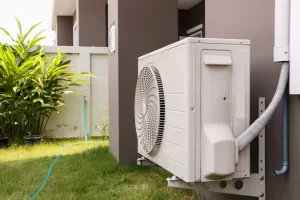
How an Economizer Saves Your Business Money
Lower Cooling Energy Use
The compressor is the biggest electricity user in a cooling system. Every hour the economizer supplies free cooling is an hour the compressor does not have to run at full load, which shows up directly as lower kilowatt-hours on your utility bill. Because commercial buildings often need cooling in interior zones year-round, those free-cooling hours add up well beyond the peak of summer.
Less Wear on Expensive Equipment
Compressors and their contactors are among the costliest parts to replace on a rooftop unit. When the economizer carries part of the cooling load, the compressor cycles less often and runs fewer total hours, which reduces wear and can push out the timeline for major repairs or replacement.
Fewer Peak-Demand Charges
Many commercial utility accounts include a demand charge tied to your highest spike of usage. By shifting some cooling to outside air on mild mornings, an economizer helps flatten those spikes and takes pressure off the compressor during the hours your rates are highest.
Better Ventilation and Indoor Air
Because the economizer brings in fresh outdoor air, it also improves ventilation. More outside air dilutes stale indoor air, odors, and airborne particles, which supports a healthier space for employees and customers.
Why Economizers Work So Well on the Front Range
Colorado’s high, dry climate is close to ideal for air-side economizers, for a few reasons.
Dry air. Economizers struggle in humid regions because pulling in muggy outside air forces the system to spend energy removing moisture. On the Front Range, outdoor air is dry most of the year, so cool air coming in stays comfortable and adds no humidity penalty.
Big daily temperature swings. At roughly a mile above sea level, the Parker and Castle Rock area sees temperatures drop sharply after sundown even in July. A day that hits the upper 80s often cools into the 50s overnight, opening a long window each morning and evening when free cooling is available.
Energy code already favors them. Because free cooling is so effective in our climate zone, Colorado commercial energy codes require economizers on many larger rooftop cooling units. If your building received new equipment in recent years, there is a good chance you already have economizers that simply need to be verified and tuned.
Types of Economizers
Not every economizer measures the same thing, and the right choice depends on the climate and the building.
Dry-Bulb Economizer
This is the simplest and most common type. It looks only at outdoor air temperature and opens the dampers when the air is below a changeover setpoint, often somewhere around 55°F to 65°F. In a dry climate like the Front Range, a dry-bulb economizer is usually all a building needs, because temperature alone is a reliable signal of when outside air will feel comfortable.
Single Enthalpy Economizer
An enthalpy economizer measures both temperature and humidity, giving it a fuller picture of the outdoor air’s total heat content. That matters most in humid regions; in dry Colorado air the added complexity often provides little benefit over a well-set dry-bulb control.
Differential Enthalpy Economizer
This type compares the outdoor air against the return air from inside the building and picks whichever is cheaper to cool. It is the most sophisticated option and can make sense for large, multi-zone buildings, but it also has more sensors to keep calibrated.
Is Your Building a Good Candidate?
Economizers pay off best in buildings that need cooling during mild weather, including offices, medical suites, retail, and warehouses with conditioned areas. If your space runs its air conditioning on cool mornings because of internal heat from people and equipment, an economizer can capture that free cooling. A technician will check whether your rooftop units already include economizer packages, whether the dampers and actuators still move freely, and whether the sensors and controls read accurately. A surprising number of existing economizers sit stuck or disabled.
Keeping an Economizer Efficient
An economizer only saves money when its moving parts and sensors are working. Because the dampers open to the outdoors, they collect dust, and the actuators and linkages can seize over time. A stuck-open damper wastes heat in winter, and a stuck-closed damper cancels the free cooling you paid for. A commercial maintenance visit should include:
- Inspecting and exercising the dampers and actuator to confirm smooth full travel.
- Checking and recalibrating the temperature and humidity sensors.
- Verifying the changeover setpoint and control sequence match the season.
- Cleaning debris from the outdoor air intake and tightening the linkages.
Folding these checks into your regular heating and cooling service, ideally in spring before cooling season and in fall before the first freeze, keeps the system honest and your savings intact.
Frequently Asked Questions
At what temperature does an economizer start providing free cooling?
Most dry-bulb economizers bring in outdoor air when it falls below a changeover point in the range of about 55°F to 65°F, though the exact setpoint depends on your building and how it is programmed. Below that temperature, outside air can meet part or all of the cooling load.
Do economizers work at Colorado’s altitude and dry air?
Yes. Dry air and the large day-to-night temperature swings common near Parker and Castle Rock make air-side economizers especially effective. The dry climate also means a simple dry-bulb economizer usually performs just as well as more complex humidity-based controls.
How do I know if my commercial building already has an economizer?
Look at your rooftop units, or ask an HVAC technician to inspect them. Many packaged commercial units built in recent years include an economizer section with an outdoor air damper and controller. The challenge is usually not adding one but confirming an existing unit’s dampers and sensors still work.
How often should an economizer be serviced?
Plan on at least once a year, and ideally twice: a spring check before cooling season and a fall check before winter. Sensors drift and dampers stick, so regular verification is what protects the savings.
Talk to a Local Commercial HVAC Team
If you manage a commercial building in the south Denver metro, an economizer is one of the most cost-effective ways to trim your cooling bills, but only when it is installed correctly and kept in tune. The licensed technicians at 1st Choice Pro Services inspect, repair, and service commercial HVAC systems throughout Parker, Castle Rock, Castle Pines, Centennial, and Highlands Ranch. Call us at 303-841-1448 to have your rooftop units and economizers checked before the next stretch of extreme temperatures arrives.
Key Takeaways
Moving your sink to an island increases your kitchen’s workflow by centralizing prep and clean-up, diminishing perimeter…
Key Takeaways
Understand typical issues such as drain clogs, incorrect installation, and pump or hose malfunctions to target fixes where…