
How Smart HVAC and IoT Systems Improve HVAC Efficiency
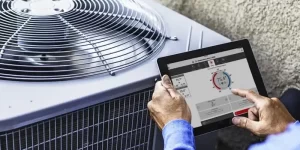
A smart HVAC system connects your furnace, air conditioner, and thermostat to the internet through sensors and a mobile app, letting you watch temperature, humidity, runtime, and energy use in real time. For Front Range homes in Parker, Castle Rock, and Highlands Ranch, that connectivity trims heating and cooling costs, catches small problems before they become emergencies, and holds comfort steady through Colorado’s swing from snowy mornings to warm afternoons.
The catch is that no single gadget makes a system efficient on its own. Smart controls deliver the biggest savings when the underlying equipment is correctly sized, the ductwork is sealed, and the system is maintained on schedule. This guide explains what smart HVAC technology actually does, where it earns its keep in our climate, and what it cannot fix.
What “Smart HVAC” Actually Means
“Smart HVAC” is a loose term for heating and cooling equipment that adds sensors, internet connectivity, and app-based control on top of the basic job of moving warm or cool air. A few building blocks show up in most Parker-area homes:
- Smart thermostats learn your schedule, respond to your phone’s location, and let you adjust the temperature from anywhere.
- Remote sensors read temperature and humidity in individual rooms, so the system balances a chilly bonus room against a sun-baked upstairs bedroom instead of guessing from one hallway reading.
- Communicating equipment – a modern variable-speed furnace and air conditioner that talk to a matched thermostat – fine-tunes fan and compressor speed rather than slamming fully on and off.
- Connected monitors for indoor air quality, whole-home humidifiers, and water leaks feed the same app, giving you one place to see how the house is doing.
How Smart Controls Cut Heating and Cooling Costs on the Front Range
Colorado’s climate is hard on equipment that runs on a fixed schedule. A February day can start below 10°F and reach the 50s by afternoon, and summer nights cool off fast even after a hot, dry day. Smart controls respond to those swings instead of fighting them.
Smarter Scheduling and Setback
A programmable setback – lowering the heat while you sleep or are away, then recovering before you get home – is one of the most reliable ways to improve HVAC efficiency. A smart thermostat automates it and uses your phone’s location so it isn’t heating an empty house on a workday. Because it also watches how long your furnace takes to recover, it starts earlier on the coldest mornings and later on mild ones.
Zoning for Two-Story and Walkout Homes
Many homes in Castle Pines and Highlands Ranch have vaulted ceilings, finished basements, or walkout levels where one thermostat cannot keep every floor comfortable. A zoned system with motorized dampers and its own sensors heats or cools only the areas in use. That means fewer wasted cycles and a smaller gap between the coldest and warmest rooms.
Humidity Control at Altitude
At roughly a mile above sea level, Front Range winter air is very dry, and forced-air heat makes it drier. Low indoor humidity feels colder than it actually is, which tempts you to turn the heat up. A smart thermostat paired with a whole-home humidifier holds relative humidity in a comfortable band, usually around 30 to 40 percent in winter, so you stay comfortable at a lower set temperature. In summer, the same monitoring flags when a home is holding too much moisture.
Catching Problems Early With Remote Monitoring
The feature homeowners end up valuing most is not the fancy scheduling – it is the alerts. A connected system watches runtime and temperature and can warn you when something drifts out of range.
- Freeze protection. If your furnace quits while you are away for a ski weekend and the indoor temperature falls toward freezing, you get an alert on your phone in time to act – before pipes freeze and burst.
- Short cycling and long run times. A furnace that turns on and off too often, or an AC that runs for hours without hitting the set point, is telling you something. Trend data helps a technician diagnose the cause faster.
- Filter and maintenance reminders based on actual runtime, not a guess, so a clogged filter is not quietly choking airflow and driving up your energy use.
What Smart Technology Cannot Fix
Honest expectations matter. A thermostat app will not rescue a system with real underlying problems, and a few of those are specific to our area.
- Wrong-sized equipment. An oversized furnace or AC short cycles no matter how smart the controls are. Correct sizing comes from a load calculation, not an app.
- Altitude derating. Gas furnaces installed above about 2,000 feet must be derated for the thinner air, and many manufacturers require a high-altitude conversion at our elevation. This is a combustion setup step, not something software adjusts.
- Leaky or undersized ducts. If conditioned air escapes into an unfinished basement or attic, smart zoning only redistributes the loss.
- Hard water and scale. Denver-metro hard water clogs humidifier pads and shortens the life of anything that touches water. Connected gear still needs seasonal cleaning.
This is where an HVAC efficiency audit pays off. A licensed technician measures airflow, checks refrigerant charge and combustion, inspects ductwork, and confirms the equipment is sized for your home before you invest in smart controls layered on top.
Getting the Most From a Smart HVAC Upgrade
If you are planning an upgrade, a short checklist keeps it from becoming an expensive science project:
- Confirm compatibility. Many smart thermostats need a common (“C”) wire for steady power, and communicating equipment only reaches its full potential with a matched thermostat from the same system.
- Place sensors where people actually are – bedrooms and living areas, away from direct sun, vents, and exterior doors.
- Set realistic schedules and humidity targets for winter and summer rather than leaving factory defaults in place.
- Keep up with maintenance. Smart alerts are only useful if the furnace, AC, and humidifier get the seasonal service they flag.
Frequently Asked Questions
Will a smart thermostat really lower my energy bill?
It can, mainly by automating setbacks and avoiding heating or cooling an empty house. The savings depend on your current habits and how well your equipment and ductwork perform. A home that already runs tight schedules will see less change than one left at a fixed temperature around the clock.
Do smart HVAC systems work with older furnaces?
Usually, yes. A smart thermostat works with most conventional gas furnaces and central AC as long as the wiring supports it. You get scheduling, remote control, and alerts, though features like variable-speed staging require communicating equipment.
How does humidity control help at Colorado’s altitude?
Front Range winter air is dry, and dry air feels colder. Holding indoor humidity in a comfortable range lets you feel warm at a lower thermostat setting, which reduces furnace runtime. A smart control paired with a whole-home humidifier manages this automatically.
Can I monitor my HVAC while I am away in winter?
Yes, and it is one of the best reasons to connect your system. Remote temperature alerts let you catch a furnace failure before indoor temperatures drop toward freezing – a real risk during a Colorado cold snap when a home sits empty.
Smart HVAC technology works best when it is installed and tuned by a licensed local team that knows Front Range homes. 1st Choice Pro Services helps homeowners across Parker, Castle Rock, Castle Pines, Centennial, and Highlands Ranch choose, install, and maintain smart thermostats, communicating systems, zoning, and whole-home humidifiers – sized and set up right for our altitude and climate. Call 1st Choice Pro Services at 303-841-1448 to schedule an HVAC efficiency assessment or ask which smart upgrade makes the most sense for your home.
Key Takeaways
Moving your sink to an island increases your kitchen’s workflow by centralizing prep and clean-up, diminishing perimeter…
Key Takeaways
Understand typical issues such as drain clogs, incorrect installation, and pump or hose malfunctions to target fixes where…