
What Is a Condensate Pump? Role, Operation, and Common Issues Explained
Key Takeaways
-
A condensate pump is a device that pumps water from your air conditioning or refrigeration system if gravity drainage is not possible. Inspect and clean the reservoir regularly and test the float switch to ensure dependable operation.
-
Match pump selection to system needs by checking lift height, flow rate, and voltage. Prioritize safety features like check valves, overflow shutoff, and thermal overload protection.
-
Mount the pump as near as possible to the condensate source, on a rigid, level surface, with a properly sloped and secured discharge line to prevent backflow, leaks, and noise problems.
-
Safeguard yourself against typical breakdowns with periodic cleaning of the reservoir and discharge lines, testing or replacing float switches, and selecting motors with thermal protection to prevent burnout.
-
Look for newer smart and energy-efficient pumps for remote monitoring, quieter operation, and lower power use. Tie diagnostics into building automation as much as possible.
-
Record the installation specifics, stash spare parts or backup pumps for mission-critical systems, and regularly maintain your equipment to safeguard HVAC efficiency and mitigate potential expensive water damage.
A condensate pump HVAC refers to a compact electric pump responsible for pumping water gathered from air conditioners, furnaces, and dehumidifiers.
It stores condensate in a holding tank and pumps it via tubing either to a drain or outdoor area. Pumps differ in capacity, size, and float-switch control, and selection is based on the flow rate and lift height.
Correct selection and regular cleaning keep backups and mold at bay. The body discusses types, sizing, and maintenance.
The Condensate Pump
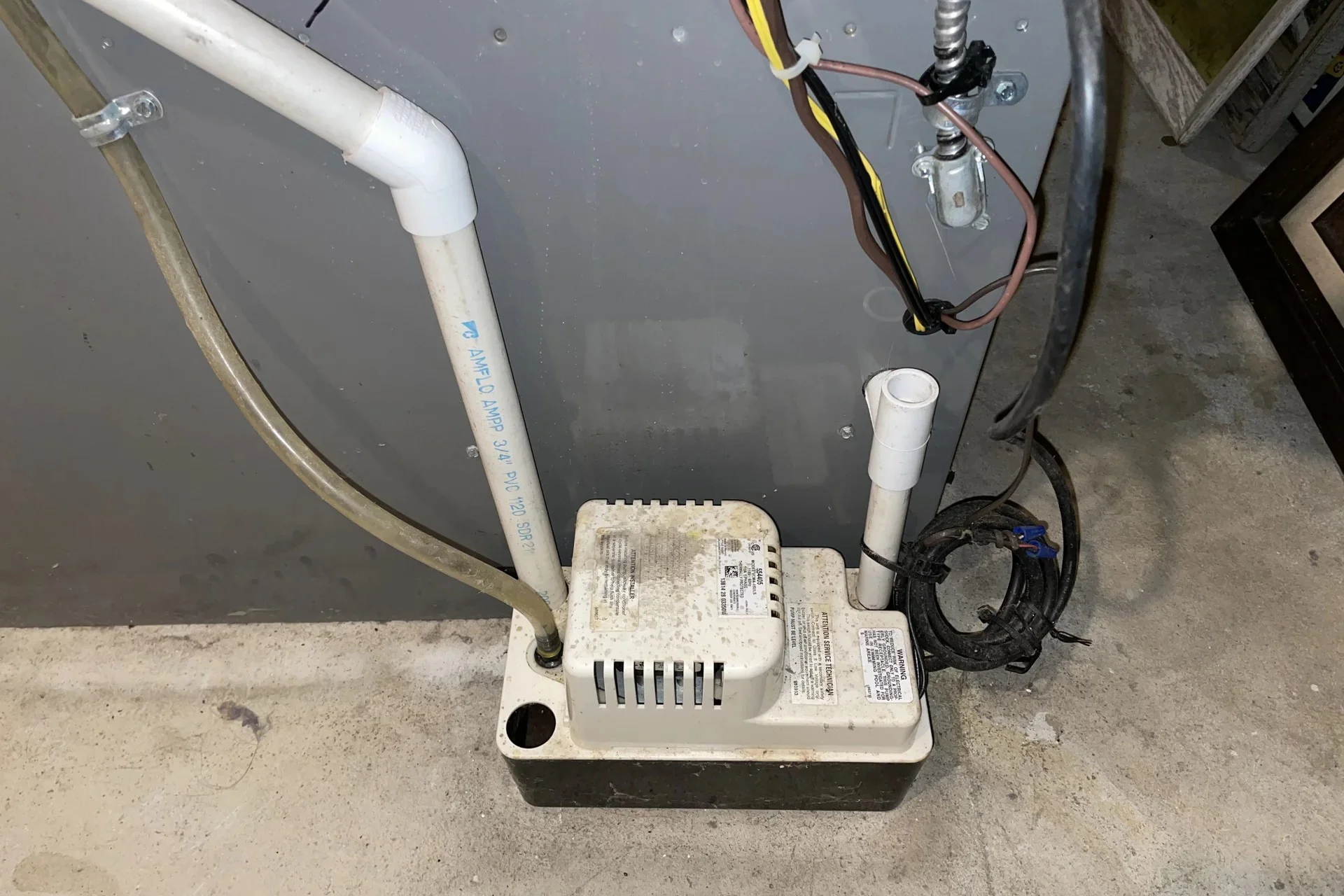
Condensate pump is a small pump that evacuates surplus condensate water from HVAC, refrigeration, condensing boiler, furnace, steam, or dehumidifier when gravity drain is not an option. It accumulates liquid in a reservoir and when a certain level is reached, it uses a small electric motor and impeller to pump the water through a discharge line to a sewer, plumbing drain, or outside via PVC tubing.
These pumps operate automatically and usually have safety features like two-stage switches to minimize the chance of build-up around vital equipment.
1. The Reservoir
The reservoir is the collection pan or tank where condensate water accumulates prior to being pumped. It needs to be sized to handle the volume generated by the connected equipment. Undersized storage tanks create frequent cycling and oversizing can hide leaks.
Keep the reservoir clean. Debris, dust, and algae build up and can clog outlets or cause bacterial growth that smells and fouls the system. Checking often catches any cracks or leaks early, as a little hairline fracture left unnoticed can cause water damage for days or weeks.
Contamination is ubiquitous. Dirt and bits from the HVAC drain lines enter the reservoir and can clog the pump or float switch, so inexpensive filters or strainers aid. In industrial steam systems, reservoirs can be larger and routed to condensate return systems rather than a sewer.
2. The Motor
The motor drives the impeller to pump condensate through the discharge line. These motors are small, electric, intermittent duty. Reliability matters: a weak or worn motor leads to slow discharge or failure, raising the risk of overflow and equipment harm.
Motor vents need air, and clogging them with dust causes heat build-up which shortens life. Occasional cleaning is sensible preventative maintenance. Since the motor is the pump’s heart, size motor horsepower to anticipated flow rates.
Overworked motors in high-volume setups fail sooner, while oversized motors waste energy.
3. The Float Switch
The float switch detects the water rising and activates the pump. Proper operation prevents overflow. Some pumps use a two-stage switch. The first stage starts routine pumping and the second stage provides an alarm or backup if water keeps rising.
Stuck floats are a primary culprit for failures and leaks. Debris or algae can glue the float or shift its buoyancy. Lift the float or pour water into the reservoir to activate the float switch and test it.
Replace or service faulty switches promptly. Don’t be caught by surprise.
4. The Discharge Line
It’s the hose/pipe that discharges condensate from the pump to a drain point. Use the right diameter and materials. PVC is common to minimize leaks and clogs. Run with a constant downward slope to prevent traps where water can stagnate and freeze in colder climates.
If the line goes outdoors, insulate or heat trace it to prevent ice blockages. Fix the line to avoid kinks or accidental disconnects and do not operate the pump with suction and discharge closed to avoid a possible pump explosion or damage.
Pump Necessity
Condensate pumps gather and transfer the water that an HVAC system sheds as it cools or condenses moisture. They’re needed whenever gravity drainage isn’t possible, when the equipment is below the drain line or when the run to an appropriate drain would be lengthy or blocked. That pump is a necessary evil.
It safeguards the unit and space by expelling liquid that would otherwise pool and cause corrosion, mold, or an electrical fault.
Gravity Limitations
Gravity drainage requires a constant downward slope to a floor drain, sink, or exterior outlet. Most installations don’t have that slope because the unit is located below the drain or the path would require drilling through floors or walls.
Basements, below grade mechanical rooms, and rooftop units with internal condensate traps are typical scenarios where gravity will not suffice. In multi-story buildings or retrofits, the pipe may run horizontally for extended distances or even rise briefly, both of which trap water.
Figure out if your installation site has elevation and drain access issues. If the condensate can’t flow naturally by slope, a pump is needed. Pumps add up when local codes prohibit open discharge or outdoor plumbing freezes in winter.
Installation Location
Position your pump near the source of condensate, usually below the evaporator coil, air handler or furnace. A short run from the drip pan to the pump decreases the risk of overflow and makes maintenance easier.
Mount the unit on a flat, stable surface to reduce vibration and noise, and secure mounting helps prevent shifting that might kink the tubing. Leave easy access to the reservoir and float assembly for inspection, cleaning and service.
Many clogs occur from sludge, algae or lint and these require regular care. Location affects pump efficiency and leak risk. A poorly placed pump may cycle excessively or allow water to reach sensitive components.
System Type
Different systems generate different volumes of condensate and require pumps sized accordingly. Air conditioners, ultra-high-efficiency furnaces, dehumidifiers, refrigeration, and other equipment all have different condensate outputs.
Condensing furnaces and modern ACs tend to generate more water and require more powerful pumps. Select a pump based on flow rate in liters per hour and head height in meters, selecting one that matches your system’s maximum output.
Check equipment specs and any local standards before purchase. A few systems in flood-prone or wet locations are required to use pumps to divert water from equipment and buildings.
Correctly sized and maintained pumps generally run sporadically under normal conditions, maybe four to five cycles per day in winter. Heavy humidifier use or very cold outdoor temperatures can cause cycling every few minutes.
When maintained, pumps can last 20 to 30 years, but if clogged with dirt or algae, they won’t live that long without cleaning.
Selection Criteria
Selecting a condensate pump involves considering multiple technical and practical criteria to ensure the pump operates dependably in the particular HVAC system. Start by matching pump capacity and form factor to the system’s condensate generation, spatial constraints, electrical availability, and maintenance accessibility.
Check out manufacturer charts and guidelines. They provide maximum head and flow curves and installation notes that save your typical mismatches.
Lift Height
Lift height is the pump’s vertical distance from its reservoir to discharge, sometimes called max head. Higher than the rated lift height decreases flow and can cause the pump to overheat or fail.
Consider total vertical rise in addition to any vertical losses from fittings and check valves. Manufacturers specify max head in metres or metres of water. Always pick a pump with some margin over your measured lift.
For tight installations, an in-pan or low-profile pump with lower head but smaller size may be necessary.
Flow Rate
Flow rate is how much condensate the pump moves, generally GPH. Dimension pump capacity to match rated flow to peak condensate output.
A good rule of thumb is 2 to 3 times the equipment’s condensing rate to prevent overflow under peak load. Homes typically require 100 to 500 GPH, while light commercial systems may be 500 to 2,000 GPH or higher.
Think about seasonality and concurrent loads when predicting peak output. Account for friction losses from long or complex discharge runs that diminish effective flow.
Voltage & Power
Choose pump voltage to site supply, typically 115 V or 230 V. Using the incorrect voltage can lead to instant failure or hazard.
Consider power rating and stage/thrust configuration. Power rating affects energy consumption and starting torque. Refer to manufacturer tables for common voltage and wattage choices and verify with local electrical codes and breakers available.
Safety Features
To minimize the risk of water damage and equipment failure, built-in safety features are essential. Overflow shutoff switches and audible or electrical alarms warn before flooding.
A check valve prevents backflow and keeps sewer gases out. Thermal overload protection protects the motor from burning out when it stalls. An obvious fill level or sight glass makes daily service a snap.
For quiet areas such as bedrooms, look at noise ratings and choose low noise models. Evaluate the installation environment, including temperature, humidity, and space, along with maintenance access for cleaning and servicing.
Minimize discharge friction by limiting elbows, using smooth pipe, and following a 6 mm downward slope for every 0.3 m of horizontal run where possible.
Installation Impact
Proper installation of a condensate pump drips beyond just removing water. It promotes HVAC efficiency, protects against damage, and establishes maintenance requirements. Installation impact decisions, such as pump sizing, discharge slope, neutralizer use, and wiring of safety switches, dictate runtime, noise, and long-term reliability.
System Efficiency
Proper condensate removal prevents water accumulation that can inhibit heat transfer and airflow. When a pump is sized to handle two to three times the calculated peak condensate rate, it removes water at a swifter pace than the worst-case load, minimizing shutdowns due to overflow sensor activation.
For context, typical systems tend to generate approximately 1 gallon of water per hour per 100 kBTU. A/C units can drain anywhere from 5 to 20 litres or more per day, depending on run time and humidity levels. Use these metrics when capacity sizing.
A properly sloped discharge pipe, around 1% or 1/8 to 1/4 inch per foot, keeps gravity flow steady. Remember to factor in fittings as every 90 degree elbow adds the equivalent of 2.4 meters of straight pipe resistance. Routine maintenance, clearing lines, inspecting the reservoir, and testing the float or pressure switch keeps the pump humming and helps extend equipment life.
Potential Leaks
Leaks typically originate from bad connections, cracked reservoirs or loose discharge lines. Check every joint, hose and fitting during and after install. Tighten clamps, use compatible tubing, and validate the seal at the pump inlet and discharge.
Install a neutralizer when dealing with condensate from high-efficiency or 90%+ AFUE units to minimize corrosive runoff. Local codes may require it. Add a leak-detection device or an alarm to warn early of overflow.
Have a pump with emergency overflow shutoff and wire it into the HVAC control where there is a risk of property damage or injury. If you find a leak, fix it immediately before it causes structural water damage and mould.
Noise Levels
Noise originates from motor vibration, water hammer in discharge lines, and improper mounting. Install pumps on solid surfaces and employ vibration-dampening pads or brackets to reduce structure-borne noise.
If you’re installing units near living or work spaces, consider opting for pumps with lower decibel ratings as you select and compare the manufacturers’ specs. Install impact insulation on the pump housing and wrap discharge lines to prevent air-borne noise transmission.
Properly routed, supported, and sloped piping reduces water impact noise during pumping cycles.
Common Failures
Condensate pumps are mechanical components which wear with age. Knowing where they typically go wrong keeps you from water damage and HVAC downtime. The usual suspects are clogs and blockages, float-switch or other switch failures, and motor burnout.
Regular inspection and cleaning, quick replacement of malfunctioning parts, and having spare components or even a backup pump for critical applications minimize risk.
Clogs & Blockages
Debris, algae, mineral scale, or a cracked reservoir allow solids and growth to accumulate in the pump well and discharge line. Severe algae accumulation is typical where moisture and light intersect. Mineral deposits build up more quickly with hard water.
Kinks, bad routing, or debris in the discharge hose generate back pressure that strains the pump. Regularly clean the pump reservoir, drain lines, and outlet line. Take off the pump cover, scoop or vacuum instead, and flush the line with water.
For stubborn algae, swish around a mild bleach solution and rinse well. Put a small inline filter or screen at the condensate inlet to protect contaminants from entering the pump. Clogs cause overflow, short cycling, and undue stress on the motor.
Overflow can ruin ceilings, insulation, and electrical components. In the worst systems, a clogged discharge line or cracked reservoir will be your trigger for system shutdowns and emergency repairs.
Switch Malfunctions
Float switches stick, wear, or become misaligned over time. A stuck float switch can keep the pump from starting or stopping at the right point. Electronic sensors can drift or lose calibration. Lack of power or loose wiring can imitate a switch failure.
Test float switches on occasion by lifting and lowering the float to ensure the pump starts and stops as anticipated. Include wiring and power in your inspections. Change a bad mechanical float or sensor before it turns off your water and shuts down your whole system.
For even greater reliability, select pumps with dual float switches or redundant electronic sensors. Dual switches are a good idea for that extra activation path and wiring to alarms and the pump. That way, it reduces the risk of single-point failure of important equipment.
Motor Burnout
Motor burnout typically results from overheating, excessive runtime from repeated cycling, or electrical issues like voltage spikes. A motor that runs non-stop due to a stuck float or a clogged line will fail earlier. Old pumps that have cycled a lot may be at the end of life and exhibit repeated failures.
Listen for odd sounds—grinding, high-pitched whine or irregular hum—indicating the motor is under stress. Install units with thermal overload protection that shut the motor down before permanent damage takes place.
Match pump capacity to system condensate load too. Undersized pumps run longer and overheat, while oversized units can cycle inefficiently.
Future Innovations
Condensate pumps will evolve with AC as demand and innovations in materials, sensors, and systems integration accelerate. Over the next decades, anticipate upgrades that boost reliability, reduce noise and power consumption, and introduce smarter methods to detect and prevent issues before they become serious.
Smart Sensors
Intelligent sensors monitor water level, pump condition, and environment, then dispatch notifications to apps or smart home hubs. These sensors can record run cycles and identify slow drainage patterns indicative of partial blockages well ahead of a catastrophic failure.
Real-time alerts allow building managers or homeowners to react immediately to overflow or power failure dangers, minimizing water damage and service visits. Pumps with integrated diagnostics make future troubleshooting easier by returning error codes and probable causes.
For instance, a sensor might identify sustained high run time, indicating a clogged drain or undersized pipe. Pairing these pumps with more comprehensive home automation systems can allow them to pause HVAC units in case of a leak or direct alerts to technicians on call.
Opt for units that have open protocols or common smart platforms to make integration easy. In bigger buildings, networked pumps can feed a central dashboard for trend analysis and predictive maintenance, assisting facilities teams in scheduling parts replacement ahead of failures.
Quieter Operation
Noise reduction is due to enhanced motor design, upgraded housing materials, and consideration of airflow paths. Brushless motors and smoother impeller shapes reduce mechanical noise and increase longevity.
Manufacturers now utilize denser polymers and composite housings that block sound instead of amplifying it. Vibration-dampening mounts and insulated enclosures are convenient accessories that reduce transferred noise to floors and walls.
For your apartment, hotel, or office, grab pumps sold for quiet operation and look up tested decibel levels at relevant distances. Compare noise ratings and mounting recommendations when replacing a unit.
Easy decisions, such as rubber isolators, soft-mount brackets, or an enclosed cabinet, may make a significant difference in comfort in noise-sensitive areas.
Energy Efficiency
Next generation pumps target lower power draw with no loss of lift or flow. More efficient motors and control logic optimized to minimize run time and electrical load cut your utility bills and carbon footprint.
Eventually, the market will come to identify condensate pumps as yet another point of system efficiency and we will see more ENERGY STAR-style certifications for these peripherals. Choose pumps with proven efficiency when possible, and service them regularly.
Clean filters, drain lines, and seals to keep performance high. Next-generation materials and miniaturization reduce quiescent losses and can make for sleeker, less obtrusive units that fit contemporary decor.
Conclusion
A condensate pump pumps water from HVAC drains to a secure drain location. It keeps systems dry, reduces mold risk, and avoids water damage. Select a pump based on lift height, flow rate, power consumption, and construction. Mount the pump level, on a solid slab, and hook it to a GFCI or dedicated circuit. Check floats and cleaning access once installed. Be on the lookout for clogs, stuck floats, rust, and failed motors. Regular checks and a basic flush extend pump life. Newer models include quiet motors and smart alerts that send a fault notice to a phone or building system.
For a one-stop, reliable setup, properly match pump specs to system needs, test after install, and log basic checks. Need a quick checklist or model recommendations for your system? I can assist.
Frequently Asked Questions
What is a condensate pump in HVAC?
A condensate pump pumps water generated by HVAC cooling and dehumidification to a safe disposal location when gravity drainage is not an option.
Do all HVAC systems need a condensate pump?
No. If you have proper gravity drainage, you don’t need one. Pumps are needed when the unit is below the drain level or in compact installations.
How do I size a condensate pump?
Size by peak condensate flow rate, typically in liters per hour, and necessary discharge head, which is the vertical lift. Include a margin for safety and occasional heavy loads.
How often should a condensate pump be serviced?
Service every 6 to 12 months. Clean the reservoir, check the float switch and tubing, and test operation to avoid backups or microbial growth.
What are common signs a condensate pump is failing?
Slow drainage, frequent cycling, water leaks or an HVAC shutdown from a clogged float switch indicate pump problems.
Can I install a condensate pump myself?
If you’re a little handy with plumbing and electricity, you can install most models yourself. For peace of mind and code compliance, get a professional HVAC technician or a licensed tradesman.
What innovations are improving condensate pumps?
Newer pumps feature quieter motors, lower energy consumption, smart sensors, self-cleaning, and corrosion-resistant materials to extend life and reliability.

Key Takeaways
Understand typical issues such as drain clogs, incorrect installation, and pump or hose malfunctions to target fixes where…
Key Takeaways
We recommend changing your evaporator pad at least once a year, prior to the heating season. Coordinate the change with…